Sep 25, 2023
Whether, why, when and how to regenerate your forest?
The life cycle of a forest is endless, but with the growth of industrial society and forest management, the man-made need to plant forests has also reached the private sector. Should you regenerate your forest, and why? How do you do it? When is regeneration mandatory, and how do you assess whether you have fulfilled your obligations?
In this article, we answer the main questions that come with establishing a new generation of forest and set out the practical steps. However, since every property is different, we always recommend consulting specialists as well as working things out yourself. For a personal regeneration plan, contact our reforestation specialist Merli Lehis, who will help create an action plan that suits your forest property.
What does forest regeneration mean and why is it beneficial?
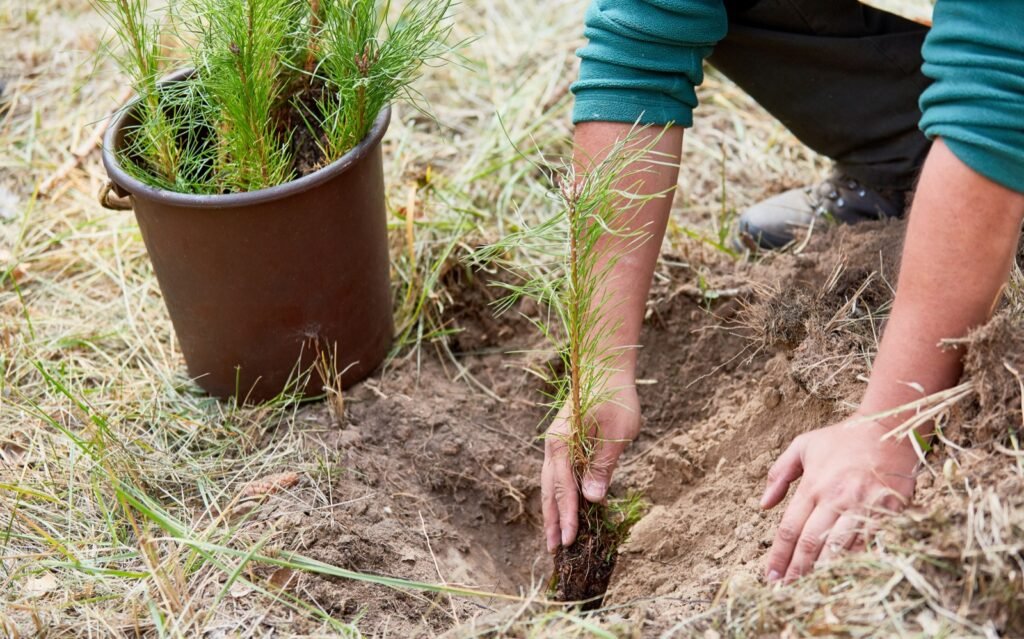
When regenerating a forest, the number of plants is increased by planting or sowing. In addition, soil scarification is often carried out to help young trees establish and to encourage the germination of naturally dispersed tree seeds. The initial practical work is followed by years of maintenance.
In addition to ecological reasons, the purpose and main economic benefit of forest regeneration is to grow a productive, high-quality forest. By regenerating your forest, you fulfil the reforestation obligation under the Forest Act and gain a new growing tree nursery. By changing the species composition of the stand, you can promote greater timber productivity.
When does the obligation to regenerate a forest arise?
According to the Forest Act, a forest must be regenerated after felling.
Under § 25 (1) of the Forest Act, as a forest owner you are obliged to apply forest regeneration methods in destroyed forest areas or clear-cuts of at least 0.5 hectares within two years of the destruction or felling.
This must be done to an extent that ensures the forest is regenerated no later than five years after felling. In other words, within five years there must be a result and the forest must have regenerated. The exceptions are the alvar, transitional bog, fen, raised bog, horsetail, sedge and swamp forest site types, where the forest has ten years to regenerate.
How is it assessed whether you, as a forest owner, have fulfilled your reforestation obligation?
The Environmental Board considers a forest regenerated if more than 1,000 spruces or 1,500 pines (at least half a metre tall) or more than 1,500 broadleaf trees (at least one metre tall) grow per hectare of clear-cut. The trees must be viable and evenly distributed over the entire area being regenerated. Trees are not required in natural closed hollows, on slash windrows and on haul roads reinforced with logging residues in a destroyed forest area or clear-cut.
The four steps of planting a forest:
1. Planning
When making a plan, ask the specialists: which trees suit your forest?
For example, you cannot establish a conifer plantation in a former alder stand, because the fast-growing broadleaf trees will crowd out the planted conifers. It is also necessary to assess whether, and to what extent, the soil supports the establishment of young trees.
Which forest crop best suits your soil?
The choice of tree crop depends on many factors. When forming your first vision, we recommend using good old common sense: if spruce was the main tree species in your forest before, plant spruce; if it was pine, plant pine.
How many seedlings should you plant for successful regeneration?
One of the most common mistakes is planting too few. According to the requirements, successful forest regeneration calls for planting 1,500 birches, 2,000 spruces or 3,000 pines per hectare. These numbers also guarantee the subsidy applied for through a forest owners’ association.
People are often surprised that forest regeneration requires so many seedlings. In fact, this number has been adjusted over time and after long trials to more or less the minimum. In the collective farm era, as many as 6,000 pines and 4,000 spruces were planted per hectare.
When forestry companies and RMK plant fewer, the smaller number of seedlings is compensated for by maintenance several times a year. In other words, planting fewer does not save costs.
2. Soil preparation
First, the ground is loosened with a forestry machine similar to a disc plough, creating furrows in the soil. This provides the best environment for young plants to establish, as there is less competition from other plants in fresh soil. Later maintenance is also considerably easier. Planting on top of, on the side of or at the bottom of the furrow also helps regulate the young tree’s water supply, which is essential on excessively wet or dry forest properties.
3. Planting the seedlings
The third step is planting the seedlings. Forest plants of Estonian origin adapt best to our forests, for a simple reason: they are already familiar with the soil and climate they will grow in. Trees grown in Latvia are also used to similar soil and climate, but seedlings from Lithuania, for example, already find it harder to adapt.
When buying plants, always pay attention to the origin of the seeds and the certificate issued by the Environmental Board.
The most important things for successful establishment are correct handling of the plants and skilful planting with the right techniques.
Make sure the young trees are planted in the right spot. Depending on how water moves on the property, a specialist can assess whether to plant on top of the furrow, at the bottom or on the side.
Do you have questions about seedlings? Need advice or a quote?
Ask the specialists at Eesti Taimekasvatus. It costs nothing.
4. Plantation maintenance
The fourth and most important stage of forest regeneration is maintaining the young plantation. Continuing maintenance for 3–5 years should ensure that the young seedlings establish in competitive natural conditions.
Depending on the site, maintenance should be carried out once, or in more difficult cases twice a year. As needed, mowing is done either just around the plant, in corridors, or across the whole site.
Good practice in the Estonian forestry landscape:
If other valuable tree species grow naturally alongside the planted ones, they are also left to grow for the forest owner. This preserves species diversity and a natural appearance.
Sowing
A less common but equally important reforestation technique is sowing. Today, sowing is mostly done together with soil scarification. Spruce or pine seed is placed in a seed hopper built into the soil preparation machine. During the work, the seed is spread evenly into the furrows, where the tiny seed can germinate in fresh soil.
The biggest advantage of sowing is its low cost. The disadvantages are high losses and an intensive need for maintenance.
A seedling is, figuratively speaking, a “ready-made tree”. A seed, however, has to start growing from scratch amid all the other developing vegetation and a harsh natural climate. It is also hard, when maintaining the forest later, to find tiny plants among lush vegetation compared with plants that are a few years old.
In our forests, the percentage of seeds that grow into trees is generally quite small.
Reforestation as an essential step after felling
Our whole team works to ensure that establishing a new generation of forest is not overlooked in the course of felling work. We believe that a key factor on this path is private forest owners’ solid basic knowledge of forestry and familiarity with best practices.
To make sure reforestation does not stall because planning feels complicated, we help everyone interested by drawing up a free reforestation plan. The easiest way to get in touch is to send an enquiry to our reforestation department.